Now that I’ve been back for a while I have had a chance to digest the experience. I got back to a family crisis and have been utterly subsumed in caregiving - which has made re-entry challenging and follow-up work temporarily impossible. Now that things are more under control I’m back to work! So a long recap with lots of details about the day to day life on the ice but also loads of pix.
There were five of us on this trip - Seth Campbell, Karl Kreutz and two grad students -Will Kochtitzky and Brittany Main - and me. Seth works largely with ground penetrating radar for his research. His long time scientific partner and senior scientist Karl Kreutz takes snow samples and ice cores to do chemical analysis to date when snow fell in what amount and where the moisture came from. Karl is a professor at the University of Maine - which is one of the four institutions Seth currently works with - the life of a scientist funded by soft money is complex to say the very least.
Will and Brittany are both PhD students - Will working with Karl at the University of Maine and Brittany at the University of Ottawa.
I flew into Whitehorse in the Yukon via Seattle and Vancouver. It turned out that Seth, Karl and Will were all on my flight so we connected in the terminal and hauled a big pile of gear out to a rental vehicle and on to the hotel where Brittany was already ensconced. The next two days were spent shopping - for groceries, maps, some bits of gear various people needed and so forth. Then Tina picked us up in her giant van and drove us 100km up to the Kluane Lake Research Station - talking all the way about the people, history and flora and fauna of the area. Her family has been in the area for generations and I learned a lot listening to her about the Yukon. On the way we passed what would be the only bear sighting of the trip - a small golden colored grizzly bear digging for roots on the side of the Alaska Highway.
At Kluane Lake Research Station (KLRS) we spent a couple days assembling gear for the flights in. This involved setting up new tents to make sure all bits were there, testing stoves, re-packing personal and scientific gear from travel mode to back-country mode (stuff has to be checked on commercial flights and fit in tiny back-country plane) and assembling food while discarding as much excess packaging as possible. Meal planning and assembling was largely Will’s job and we did NOT go hungry!
A little about the Kluane Lake Research Station where we staged and where I spent more time after getting off the ice. KLRS is now run by the Arctic Institute of North America. It has a mix of housing, dining hall, work space, lab space and storage for the various research groups that operate there - most of whom are there for relatively brief stints but may need to store gear the rest of the year. It runs along Kluane Lake and is separated from Icefield Discovery by the width of a gravel air strip. The Icefield Discovery folks run both a field camp on the ice and a pair of small nimble planes to transport researchers, climbers and sight-seers in and out of the St Elias Mountains including Mt Logan - the latter being the tallest mountain in Canada and the most massive in the world. They do logistical support for many different groups in the field. All of our flights in and out were flown by Tom Bradley- whose calm demeanor would make the most nervous flier relaxed. The little planes he and Sherpal Singh fly would take us 1 or 2 at a time plus up to 750 pounds of gear (including our weight).
Flying in took three trips. Seth and Karl went in first with essential camping gear and food. One rule of this sort of expedition is that no one flies in without survival necessities - which makes excellent sense when you think about it. Brittany and Will flew in next with more camping gear and whatever science stuff fit. I came in last with my personal gear and all the rest of the science gear. The science gear included multiple ground penetrating radar set-ups since both Seth and Brittany had their own and the needed equipment to drill ice cores and store samples for later analysis. (I should mention that for this trip Karl was not keeping cores frozen but rather bringing back little sealed bag of samples - all meticulously labeled and logged - which were allowed to melt since he was doing chemical analysis only. Had he needed to keep cores frozen it would have been a much bigger production). Logging data carefully and labeling correctly is obviously critically important and very time consuming in the field. From all this you will gather we did not travel light!
 |
| Landing on the icefield |
When my turn to go came it took more than an hour for Tom, Sherpal and Lance (mechanic extraordinaire) to play a complex game of tetris to get all the remaining gear in the plane. Then an errant gust of wind snapped a hinge on the pilot’s door so Lance calmly took the door off and attached a new hinge-plate. When I arrived 2 hours later than expected camp was all assembled with cook tent dug in and latrine ready, all tents but mine set.
That skips over the flight in - which was one of the high points of the trip for me. Kluane Lake is - or rather - was - fed by the Slims (trad. A'ay Chu) River) which used to flow out of the Kaskawulsh Glacier. Last summer the glacier receded far enough that it changed where it drains so the river no longer feeds the lake but rather flows in an entirely different channel to the Bering Sea. As a result the lake level has dropped more than a meter leaving boat ramps high and dry. The lake is quite deep - maybe 160 meters so from an ecosystem standpoint this is not yet disastrous but it is a problem for the local fishermen who can no longer easily put into the lake and many First Nations people count on that for at least part of their living. So I was very interested to fly over the river and Kaskawulsh outflow and to photograph it.
 |
| Mostly empty Slims River channels |
The flights in and out were very dramatic. The St Elias Mountains are both extremely tall and rugged - and very massive. I had watched a fair amount of video of flights in them but of course experiencing it was far more intense as the little plane bounced on the wind. I’m not a particularly nervous flier but was happy to be flying with someone as vastly experienced as Tom. After almost an hour's flight and about 160 kilometers through the mountains we abruptly dropped over a ridge and landed.
 |
| 2 arms of the Kaskawulsh Glacier |
 |
| Above icefields |
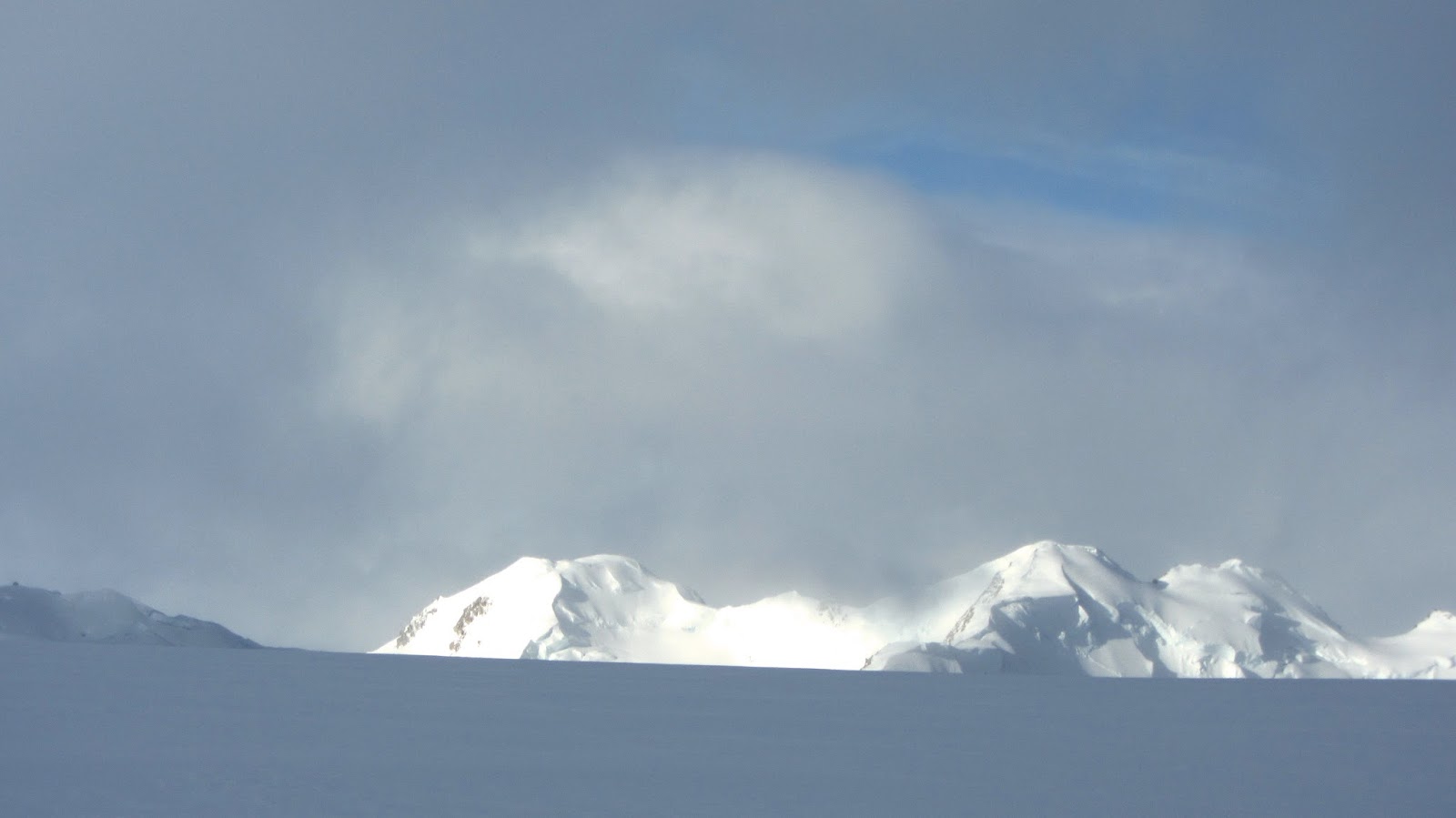
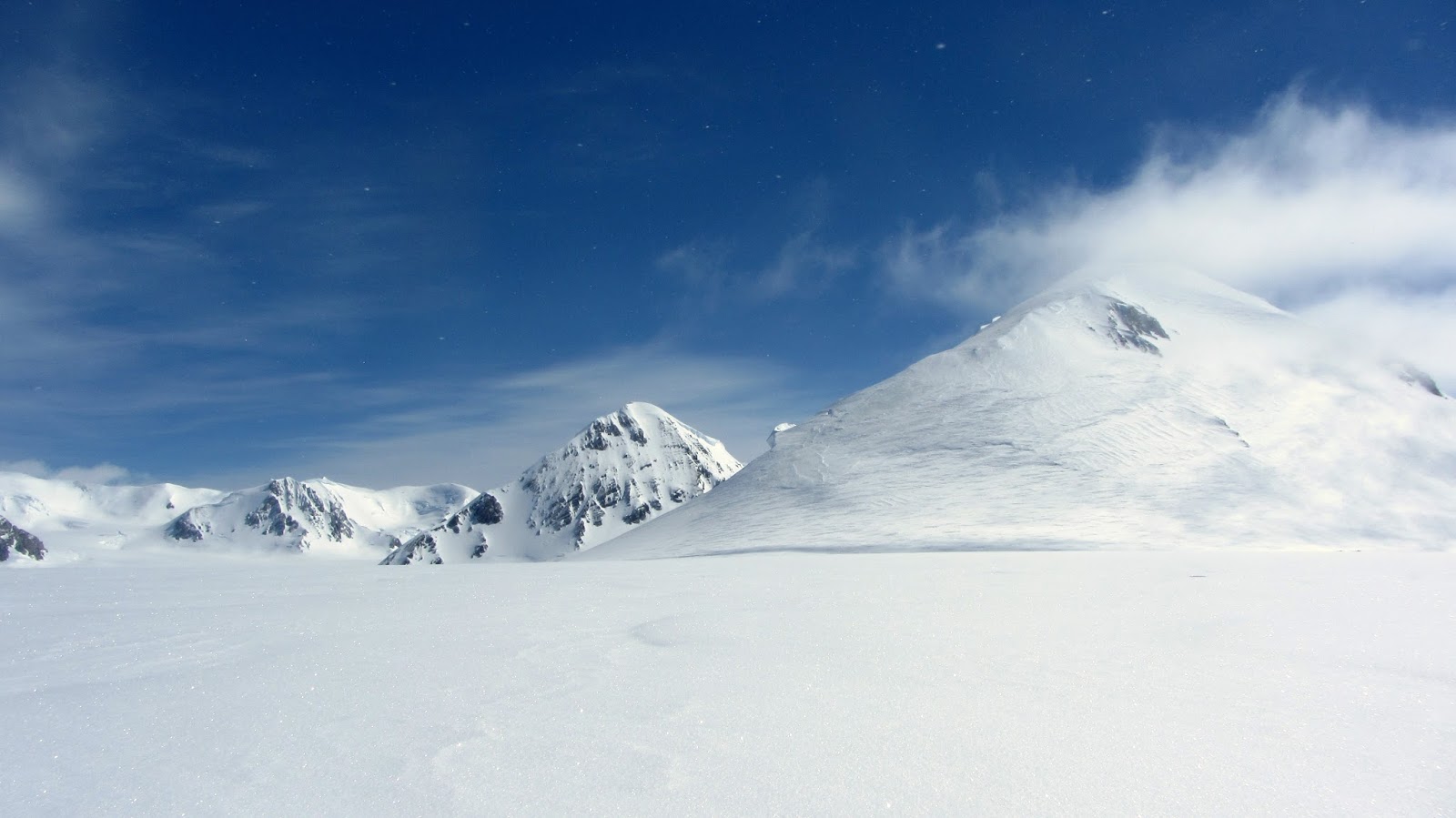
Our campsite on the Eclipse Icefield was essentially in a shallow bowl surrounded by good sized peaks including Mt Donjek and Mt Badham. Seth and Karl have been returning to this area for a number of years to gather data. It’s a relatively safe, sheltered glacier at 10,000 feet - a good place to train people in the requisite skills to do radar and ice core work and glacier camping. Neither Will nor Brittany were the kind of novice I am but Brittany commented to me that a PhD in glaciology is in part an apprenticeship in both field and research skills. Seth in particular is a deeply expert teacher of the kind of wilderness skills required to work in extreme settings and I am deeply grateful for his and Karl’s willingness to take me along.
 |
| Camp with view obscured by snow |
Seth helped me set up my tent, imparting some key information along the way. I’m an experienced backpacker although most of my backpacking is in the desert. There are some key differences about setting up a tent on an ice field 750 meters deep! For starters we don’t use normal tent stakes but 2 foot long pieces of bamboo with climbing pickets at the corners. (A picket is a right angle length of aluminum with tie-down holes. It’s about 20 inches long and is a far more stable anchor than a stake). We used every tie-down attachment on the tent so that a big storm would be unlikely to tear the tent or break a pole. While we had a fair amount of snow and wind, Seth and Karl would experience far worse a few days later in more exposed location on Mt Logan and we heard from the pilots about 140 knot winds in that location destroying climbers’ tents.
 |
| Seth and camp - note large amount of science gear in center |
You may be wondering how one sleeps in a tent on a glacier without freezing. The answer for me was sleeping ON two closed cell foam pads plus a thermarest and IN two nested sleeping bags with a liner and the tent itself was a 4 season tent. Add a hot water bottle and two layers of merino long johns and I was warm enough. Omitting one layer of long johns or the hot water bottle not being hot enough meant a chilly night. In the morning everything inside the tent has a layer of hoarfrost so clothing gets put away or kept in sleeping bags with one. I also slept with ALL of my camera batteries in the sleeping bag and my sunblock (so it would not freeze) and my headlamp. Yes it was lumpy!
This brings me to a general point about gear. The scientists all do multiple trips a year to this sort of environment. As a result they had specialty gear that I didn’t purchase because I was trying to make do with things I could re-use in less harsh environments. Examples of specialty gear include sleeping bags rated to minus 40, down filled pants and winter over-boots which go on top of ski or hiking boots. I had serious winter gear but not those items. I wore the aforementioned two layers of wool long underwear, a heavy wool sweater knitted for me by friend in Norway years ago, down sweater, down jacket and gore-tex shell when it was really cold. On the bottom went 2 layers of heavy wool hiking socks, soft shell pants over the wool long johns and gore-tex pants over that. I had winter hiking boots allegedly rated to -40 and added hand warmers between socks when needed (brought to keep batteries warm - all my camera batteries were carried in my inner pockets). I had a heavy Nepalese wool hat lined in fleece and a merino neck gaiter. When it was really cold I wore those and had my down hood up and my gore-tex shell hood up over that as well. In the afternoon it might be warm enough to just wear a baseball cap for several hours. The sun was up for 19 hours a day and it never got really dark but it definitely got a lot colder by late afternoon. I had a pair of windstopper gloves and heavy over-mittens (wore the latter as little as possible since they made it impossible to do anything precise like photography). My hands felt numb for days after getting off the ice but I did not have frostbite.
 |
| skiing with radar |
 |
| Snow coming in and dressed for colder conditions |
It gets a lot colder later in the day
 |
| Scientists heading out for yet another data collection trip |
The last full day we were at Eclipse the scientists all skied down and back up Donjek Glacier towing multiple radar arrays. They skied a round trip of 24 kilometers - roped together in climbing harnesses and towing heavy gear. I did not go since I was lacking the correct equipment. This was the one outing I did not regret not having the gear for - it was an extremely long, physically demanding day and they were all utterly spent when they got back. Being alone on the ice that day was magical and likely the most alone I will ever be. The four of them were the closest humans - anyone else was more than 100 kilometers away. There was no wind that day - it was utterly quiet - just me, mountain after mountain and the ice.
We stayed on the ice for one day longer than originally planned so that all the science objectives could be met. The original plan was that Seth and Karl would be flown to base camp on Mt Logan and Will, Brittany and I would fly out. Seth and Karl would be joined by Adam and Aaron to spend 3+ weeks on Mt Logan getting data and ideally summiting. From the get-go this was challenging. The forecast the day we flew out was a limited window before weather was coming. The Mt Logan campsite was far more exposed as mentioned earlier so Seth and Karl hunkered down on the Eclipse to wait out the storm. It took multiple days before it cleared enough for Adam and Aaron to join them and to move everyone and their gear to Mt Logan. Their entire time on the mountain was made difficult by lousy weather and they never did summit but they did get good data and everyone got out safely.
The day we flew out Will and Brittany flew out first with most of their gear. Tom came back for me and my stuff and kindly flew me around a bit more so I could do more photography.
More about the experience, my time at Kluane Lake Research Station and art-making in separate posts to come...